
Loading
.
.
.
Group Discussion (GD) Basics
3 Biggest GD Mistakes (Must Avoid)
15-Second Contribution(for nervous speakers)
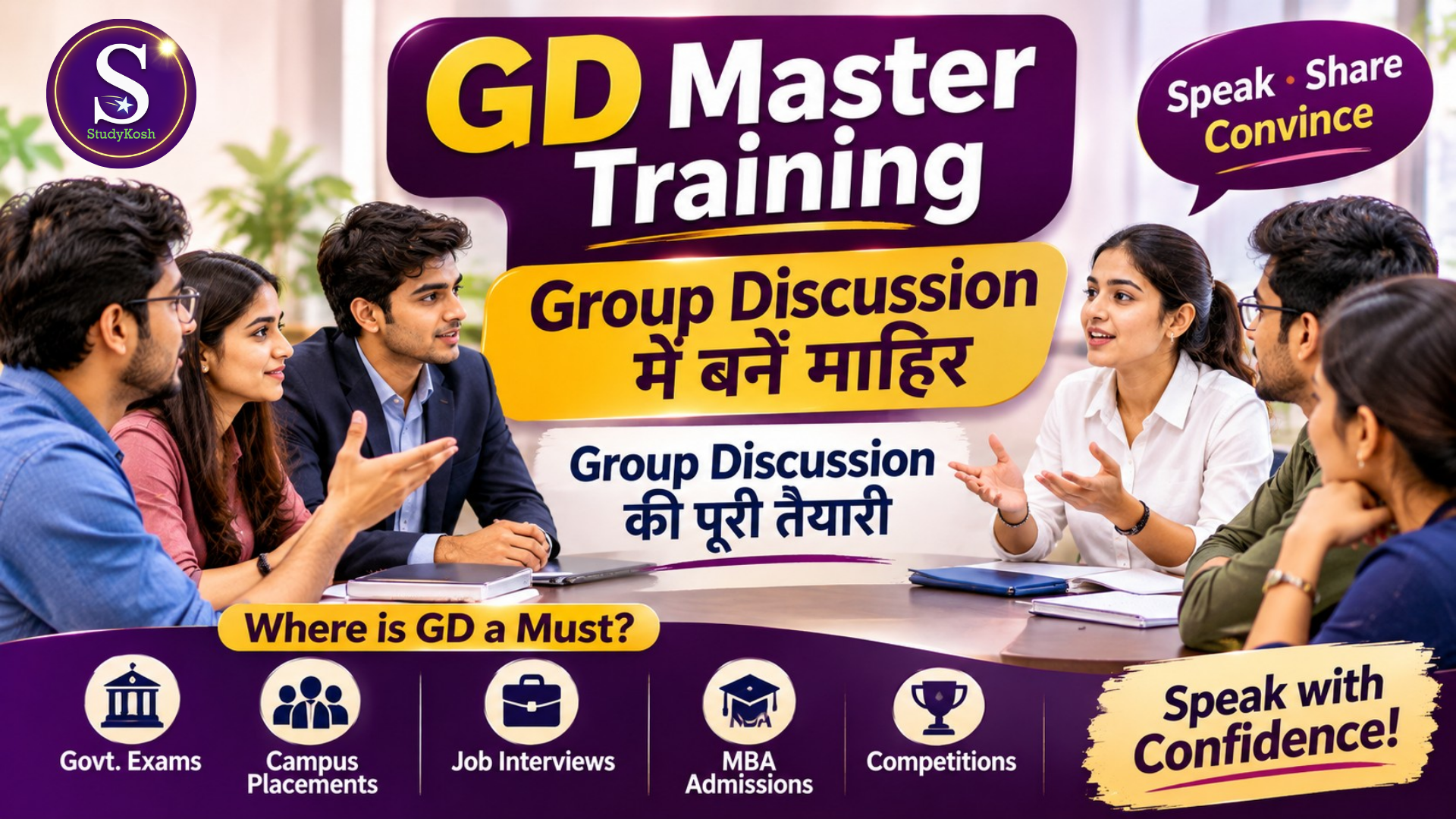
Are you nervous about speaking in a group? Do you struggle to initiate a discussion, express your opinions, respond to opposing viewpoints or make your presence felt during group discussions?
Group Discussion (GD) is much more than simply speaking in front of others. It is the ability to think critically, communicate ideas logically, listen actively, respect different perspectives and contribute meaningfully to a common discussion.
The StudyKosh GD Master Training Program is designed to help learners develop practical group discussion abilities required in academic, professional and competitive environments.
This programme focuses on helping participants understand how effective group discussions work and how to become confident, thoughtful and valuable contributors in a group.
Group discussions are commonly used to evaluate a person's communication abilities, thought process, awareness, teamwork, leadership potential and ability to handle different opinions.
Many individuals have excellent knowledge but struggle to demonstrate their abilities during a group discussion. Some hesitate to speak, some speak without structure, while others find it difficult to respond when someone disagrees with them.
This training programme aims to bridge that gap by developing the practical skills required to participate effectively in group discussions.
Whether you are preparing for campus placements, MBA admissions, job interviews, government recruitment processes or professional discussions, this programme helps you work towards becoming a more confident and effective participant.
Group discussions are an important part of several selection, assessment and professional processes.
Your ability to communicate, listen, analyse and contribute can influence how others perceive your suitability for an opportunity.
Effective GD skills can help you:
Express your thoughts clearly and logically.
Initiate a discussion confidently.
Contribute relevant and meaningful points.
Present arguments with clarity and reasoning.
Listen carefully and respond appropriately.
Handle disagreements professionally.
Participate without dominating others.
Demonstrate leadership and teamwork.
Maintain composure during challenging discussions.
Build a stronger presence in group interactions.
1. Campus Placements
Many organisations use group discussions as part of their campus recruitment and selection processes. Effective GD skills help students demonstrate communication, teamwork and analytical abilities.
2. MBA Admissions
Group discussions may form part of the selection process for management programmes and business schools. Candidates are often assessed on their ability to analyse issues, communicate ideas and interact constructively.
3. Job Interviews and Recruitment
Certain employers use group-based assessment activities to evaluate candidates' communication, collaboration, decision-making and problem-solving abilities.
4. Government and Competitive Examinations
Some competitive recruitment and selection processes include group-based discussions or interactive assessment exercises. The specific requirements vary by examination and recruitment authority.
5. Academic Environments
Students may need group discussion skills for classroom activities, academic projects, seminars, debates and collaborative assignments.
6. Corporate and Professional Environments
Professionals regularly participate in team meetings, brainstorming sessions, strategy discussions and decision-making conversations where effective participation is important.
The GD Master Training Program is suitable for individuals from different educational backgrounds and professional fields.
School Students
Develop confidence in expressing opinions.
Participate more effectively in classroom discussions.
Improve listening and speaking abilities.
Learn to present ideas logically.
College Students
Prepare for campus placement assessments.
Develop confidence in group interactions.
Improve communication and teamwork.
Prepare for management entrance and admission processes where GD is used.
MBA Aspirants
Develop structured discussion abilities.
Improve analytical thinking and argumentation.
Become more comfortable with different viewpoints.
Prepare for group-based admission assessments.
Job Seekers and Working Professionals
Improve professional communication.
Participate confidently in workplace discussions.
Develop collaborative problem-solving abilities.
Strengthen their performance in group-based assessments.
Competitive Exam Aspirants
Improve confidence during interactive selection activities.
Develop logical expression and discussion skills.
Become more comfortable discussing current and general topics.
Through structured learning and consistent practice, you will work towards developing:
Greater confidence in group discussions.
Improved clarity of thought and expression.
Better logical reasoning and argumentation.
Stronger listening and response skills.
Improved ability to initiate and conclude discussions.
Greater awareness of group dynamics.
Better management of disagreements and conflicting opinions.
Improved teamwork and collaborative communication.
Greater confidence in selection-oriented GD environments.
A more organised and professional communication style.
The programme is designed with accessible learning in mind. Participants can learn the principles of effective group discussion and develop their skills through structured training.
The training is intended to help learners understand not just what to say, but also when to speak, how to contribute and how to interact effectively with other participants.
A successful group discussion participant is not necessarily the person who speaks the most. It is the person who contributes meaningfully, listens carefully, thinks logically and communicates effectively.
Develop these abilities and prepare yourself for the group discussion opportunities that matter in your academic and professional journey.
Basic Understanding of English: Beginners can enrol; prior fluency is not required.
Learning Device: A smartphone, tablet or laptop with a stable internet connection.